https://finet52.com/the-ultimate-guide-to-japanese-seafood-from-premium-sashimi-to-iconic-street-food-skewers/
In the streets and alleys of Japan, there is a delicacy that always emits a tempting aroma, attracting countless diners to stop and taste, and that is octopus yaki.
Octopus yaki, also known as “タコ烧き” in Japanese, is a highly representative Japanese snack. It originated in Osaka, Japan. In 1933, foodie Ryuji Endo innovated based on “Akashi yaki” and initially only used beef tendon, konjac, and other ingredients added to wheat flour paste for frying and selling. In 1935, he switched to using octopus as the main ingredient and made a special powder, officially creating octopus yaki. Nowadays, octopus yaki, skewered pork chops, and Osaka yaki are known as the “three major fast foods in Osaka”, becoming representatives of Osaka’s fast food culture and witnesses to the historical development of Osaka.

The process of making octopus stew is full of fun. Its main ingredients are octopus and octopus powder, and it is also paired with auxiliary ingredients such as carrots, cabbage, onions, etc. The specialized baking tray has rows of circular concave holes. First, brush the baking tray with oil and heat it up. Pour the prepared batter into the concave holes until it is slightly formed. Then, add octopus and vegetable pellets, and turn it over halfway before adding the batter. Continue flipping and adding the batter until round balls are formed. Finally, brush the baking tray with oil and fry over low heat until the surface is golden brown and crispy. This freshly baked octopus stew has a golden color, crispy outer skin, and when bitten open, it is wrapped in tender and elastic octopus pieces, exuding a delicious aroma.
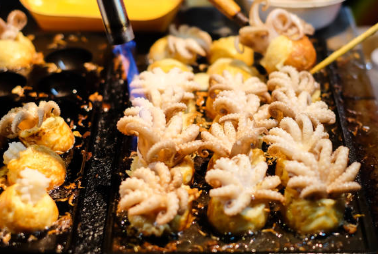
The way of eating octopus stew is also quite particular. The earliest people used to eat skewered bamboo sticks, but in Osaka they usually eat with toothpicks, while in Tokyo they often eat with chopsticks. The most orthodox way of eating is to buy and eat immediately. When tasting, to prevent being scalded, do not swallow it in one gulp. You can use a toothpick to gently stir it, wait for the heat to dissipate, then pair it with barbecue sauce, salad dressing, sprinkle with crispy seaweed, salty and fresh wooden fish flowers. Multiple flavors blend together in the mouth, and the taste is extremely rich. If left for a long time and heated in the microwave, the octopus stew will become sticky and soft, and the taste will be much worse than when it was just made.
With the development of Japan’s tourism industry, octopus yaki is not only widely popular among Japanese people, but also gradually becoming popular in Southeast Asian countries. In 2001, octopus was introduced into the mainland of China. After years of development, octopus has become one of the most popular Japanese cuisines in China. In anime works such as “Gintama”, “One Piece”, “Crayon Shin chan”, etc., the figure of Octopus Burner can often be seen, which is often used to create a warm and joyful atmosphere. In 2006, the Octopus Roast Museum, themed around Octopus Roast, opened in Osaka. It gathers several well-known Octopus Roast shops, where visitors can not only taste various flavors of Octopus Roast, but also purchase related specialty souvenirs.
In different regions, there are some changes in the processing details of octopus yaki, such as replacing milk with broth and sake, or adding ham cubes, scallions, shrimp, cucumber slices, etc., to make the taste of octopus yaki more diverse. Whether in bustling commercial streets or lively alleys, octopus yaki has conquered people’s taste buds with its unique charm and has become an indispensable part of understanding Japanese food culture.
https://finet52.com/the-ultimate-guide-to-japanese-seafood-from-premium-sashimi-to-iconic-street-food-skewers/
Related Posts

There are various ways to eat Korean fried chicken, but there is always one that you can’t stop eating
This article has been updated and moved. Click here to…
Enjoy Japanese Rice and vegetable roll stuffing, and see what’s your favorite match
This article has been updated and moved. Click here to…

The Ramen Showdown: Tonkotsu, Shoyu, Miso—Which One is Your One Pick?
This article has been updated and moved. Click here to…